Showing posts with label guided reading. Show all posts

October 31, 2013

Three Things Thursday

ONE
Happy Halloween!  Do you want to know the saddest thing ever?  Our Halloween parties at school this year were not allowed to have food at them.  AT ALL.  Not even fruits and veggies!!  This is a tragedy to sweet tooth, perpetually starving me.  As a proponent of healthy living, I am all for teaching kids healthy habits by limiting sweets in the classroom, but what a bummer to not be able to serve even healthy snacks!  Oh well.  My room moms have managed to fill the hour chunk of party time with an agenda of crafts and games.  Here's hoping we are able to keep the chaos to a dull roar today...

In other Halloween news, my team and I are "dressing up" as characters from Diary of a Wimpy Kid.  Our whole staff is supposed to come as book characters, and we chose this because it's quick and easy.  Jeans, tshirts, and a "wimpy kid" mask. :)  Easy peasy lemon squeezy!  I'm hoping it's a hit with the kids.

TWO
I wore heels yesterday for the first time since pre-marathon training back in spring!!  I had no weddings or really formal events this summer, so I pretty much lived in sandals and TOMS.  Once school started again, I was super paranoid about the slight bit of plantar faciitis I was experiencing turning into something more serious before the marathon, so I stuck to flats and other comfy shoes.  It was nice to bust out a pair of pretty shoes finally, although I have to say I am not sure I'll be wearing them as much as I used to now that I've gotten so used to comfier shoes!

THREE
I've blogged before about our BANANAS schedule this year, so no need to get into that.  But with literacy intervention groups back to back with guided reading, I basically don't move from my guided reading table and see groups for an hour and a half solid.  You can imagine what my brain is like by the last groups of the day.  Today, I passed out the books for one of my groups, a biography of Thomas Edison.  To get started, I asked them to turn and talk about some of Edison's famous inventions.  The kids stammered and guessed random inventions before I said something like, "What?  No!  You don't remember?  Look back through the book!"  So they looked back and came up with some of the inventions.  Phew.  THEN I asked, "Okay, what chapter did we get up to yesterday?"  They responded with..."We haven't started this book yet.  We finished our last book yesterday."  DUH.  Hence why they were clueless about Thomas Edison...I felt terrible!  But honestly, who can keep it all straight!  These are all the titles we've been working with the last week and a half, and this doesn't even include my intervention group's materials...

YIKES!  No wonder my brain is a jumbled mess!

Okay, I know this is supposed to be just three things, but I have one more cutie to sneak in...We've been working on informational writing including crafting strong leads.  The kids are all about onomatopoeia, but this kid seems to have missed the mark on a benchmark writing assessment...

I can't say I would classify that as onomatopoeia...but good try, kiddo!  

What are your Halloween plans?

Are you still allowed to have Halloween parties at school?

Share your "tired teacher" moment of the week--please tell me I'm not alone!

June 16, 2013

A Day in the Life of our Daily 3

This post is a follow up to last week's post about how I create, run, and take data on Guided Reading groups.  

Some of my most popular posts are about my Daily 3 structure: Daily 3 Bootcamp, Introducing the Daily 5, and Word Work.  I wrote all three of those posts during my second year teaching, though, and my Daily 3 has continued to evolve since then.  I wanted to take you through a breakdown of how I allocate my 60 minutes a day of guided reading time.  This year, my guided reading block was first thing in the morning.  Every morning after the kids unpacked, they grabbed their book boxes and joined the class at the carpet with them for our opening traditions.
This bulletin board is from a few years ago, but I make essentially the same one every year!

8:45-8:50 Opening Traditions & 1st round Status of the Class
In my earlier posts about Daily 3, I shared pictures of a packet I gave kids of graphic organizers and response questions for the week.  The first page was a blank schedule for them to fill in their Daily 3 choices for each rotation for the whole week.  It worked for me at the time, but I scrapped it last year because it just wasn't working anymore.  Also, the packets were becoming a pain to make and weren't really working with my instruction anymore.  Instead, I started taking a Status of the Class before each rotation.
Here's a sample template for my Status of the Class form.  The one I used this year had 3 columns for each day because I did 3 rotations.  I type the kids' names in at the beginning of the year and make a bunch of copies so I can pull out a new one each Monday.

Status of the Class is straight from the Daily 5 book.  What I do is read every student's name, and they tell me their choice for that rotation: Read to Self, Work on Writing, Word Work, or Guided Reading.  When I first read the Daily 5 book, I didn't really see the need for it, but since then I've decided that the minute it takes is definitely worth it.  Here's why:
  1. It helps the kids set a purpose for their rotation.  Nobody is, 5 minuets in, still deciding what to do.  Everyone has a task in mind, a purpose, and is able to start working productively right away.
  2. Keeping track of their choices helps me keep them on track.  Because I record the choices during the week on my clipboard, I am able to notice if students haven't been choosing Read to Self enough, or if it's Thursday and they still haven't chosen Word Work. (1 activity of WW must be completed by Friday.)
Once I have called their name and they have given me their choice, they go immediately to find a spot for the rotation.  If they need Word Work materials, they head right to the Word Work station to get what they need before getting settled elsewhere.
Word Work activities are stored in a hanging file bin on a trap table in the corner of the room.  

8:50-9:10 Rotation 1
I meet with my first group of the day.  Check out this post for a detailed description of how I use each minute of my guided groups. Students working independently are seated all around the room: at their desks, sitting on the floor, laying on backs, laying on tummies, laying on upside-down chairs, sitting on desks, sitting under desks, you name it.  The kids have their book boxes with them ALWAYS--they contain their Writing Workshop journal, their Word Work folder with any "in progress" and "completed" activities (to be turned in Friday), and of course a bunch of books.
9:10-9:11 Transition & Status of the Class 2
I ring my service bell.  Students in my guided reading group return pens and put their books in their cubby. (I have a cubby for each guided group at the end of my students' coat rack cubbies.)  All students pick up their book boxes and return to the carpet area for Status of the Class.  Same routine as before!
Gathering Place!
9:11-9:30 Rotation 2
I meet with my second group of the day.  Independent students are encouraged to choose a NEW spot, but this one is tricky to enforce because I am hurrying (always, always hurrying...) to start my second guided group.  Same routine as before!
9:30-9:31 Transition & Status of the Class 3
I ring my service bell again and we meet back at the carpet.  I take the last Status of the Class, making sure every student chooses a DIFFERENT activity than the first two rotations.

9:31-9:45/9:50 Rotation 3
I meet with my third group of the day, usually one of my "beyond" level groups because the time block is shorter.  Independent students are encouraged to choose a NEW spot.  Same routine as before!
Curled up in the library = 1 of many possible reading spots!
9:45 Transition to next subject
I ring my service bell, get students' attention, and give directions for the next activity of the day.  Students return book boxes to under their desks and return pillows to designated locations.

And that's a wrap!

 You can now download a pack of my Guided Reading templates for FREE on Teachers Pay Teachers!  All I ask is that you pay it forward and share the awesome resources you create with the teachers in your life!

June 6, 2013

Guided Reading Groups 101

If there is one subject I was completely unprepared to teach out of college, it was Guided Reading.  In fact, my student teaching cooperating teacher didn't even include guided reading groups as part of her literacy instruction--she was totally amazing, but guided just wasn't standard at her school!  Since starting teaching, guided reading is one of the areas that I have worked hard every year to develop and continue tweaking to fit the needs of my students.  It is always evolving in my classroom and is in no way perfect, but I feel it is one of my stronger subject areas as a teacher.  I've published several posts about my Daily 3 (modified Daily 5) structure and activities, but those have mostly focused on what the rest of the class is doing when I'm meeting with guided groups.  Last school year, I shared a post about some changes to my guided reading.  In the past two years, I have worked a lot of bugs out of my groups, and I'd like to share some details about how I create my groups, what I use for resources, how I plan for groups, and how I take data on my readers.

Guided Reading Space + Materials
Here is my guided reading space:
It's not super cute, but it works!  I use two trap tables pushed together instead of a bean table because they take up WAY less room, and I also think it's easier to lean across the table and listen to kiddos read.   The kids sit on little stools I got from Ikea--WAY easier to squeeze them in there on stools instead of chairs!  For a minute two summers ago during the big Crate Seat Craze I considered making those, then decided they were too much work and went shopping.  These babies were super cheap anyways.  The tables are arranged in front of a white board so I can write the group's "Focus Question" and stopping point on the board--saves a lot of, "What page am I supposed to stop on?" annoyances during the group!  I also have a whole bunch of pens, highlighters, markers, post-its, and index cards available in the little bins on the table, my little bell, and of course the books.  I also have these little "I'm Finished!" cards taped on the table:
Here's my guided reading binder:
I got the cover on TPT last year as a free download from "A Modern Teacher."  Pretty!  My guided binder holds a few things: a break down of who is in which group currently, resources about guided reading levels and questioning, lesson plans, and data sheets for each kid.
Creating Guided Reading Groups
Sorry about the blurrines, but I am super paranoid about sharing anything with kids' names, even first names.
I create my groups in fall using Fountas & Pinnell testing and occasionally MAP test data, but mainly F&P.  This year I ended up with way more groups than I would usually prefer, but it's just what had to happen.  I try to have a range of just 2 levels per group, maybe 3 if I have to.  During the year, I update their F&P level based on informal data taken during guided (more on that in a minute).  I DO NOT F&P test the kids all year long.  Who has that kind of time???  I move their level if I note in my data that they have been super successful at a particular level and are ready to be pushed up.  I am pretty fierce about monitoring their levels and pushing kids up all year--in the past I have let kids get "stuck" in approaching text just because I didn't know any better.  Now I really try to push them into harder texts and scaffold; usually the kids will step it up after a week or so.

Guided Reading Structure
I plan to do a second post that gives a detailed description of how I run Daily 3 down to the minute, but I'll give the basics now.  This school year I had a full hour in my schedule for guided reading time and was able to meet with 3 groups a day.  I also had an ELL teacher for guided support for 2 of those rotations, so collectively we were able to see 5 groups per day.  I try to see the needier groups first for about 20 minutes each and save the last 15 minutes or so for one of my groups of higher readers who need a little less time for building background and support.

Here is an example of my plans:
I simplified them quite a bit from the version in this post from last school year, and this template worked great for me.  Here's the breakdown of how I try to allocate those minutes for guided:
  • 2-3 min: Build Background, introduce skill, review objectives and sentence frame
  • 1-2 min: Set purpose for reading with a "focus question" and assign chapters to read (write this question on the white board)
  • 10-12 min: Students read assigned chapters.  I conference with 2 students to listen to their reading and take data on fluency/accuracy as well as comprehension.  After reading, students respond to focus questions and complete "I'm Finished" activities--see above picture.
  • 3-5 min: Discuss responses as a group or with turn & talk partners.  Make predictions for tomorrow, fill out graphic organizer if using one for this week's skill.
I typically read two books per week with the groups I see every day and one book per week with the kids I see 2-3 times a week.  I use our series's (Treasures) Leveled Readers, books from our school book room, and Reading A-Z printable leveled books.  

Data
The back chunk of my guided reading binder is divided up by each guided group.  I always let them choose their own group names and change them midyear if they want. In each section, each student has a data sheet with spots on front and back for 4 total conferences.  Once their sheet is filled, I file it and start a new one.
As I said earlier, during each rotation I try to conference with two students.  I will take an informal running record to gather fluency data while they are reading and also take data on their accuracy with answering comprehension questions.  I will give them an overall comprehension "rating" and write down any other relevant notes about things I am seeing.  When I'm writing down comprehension info, I try to at least indicate what type of questions I'm asking, whether it's a skill like inferential, main idea, cause and effect, or a level of Blooms like synthesize, evaluate, or simply a right there or summarize question.  If I have time or if it were an especially tricky question that the student struggled with, I will write down the whole question, but I don't usually have time for that.
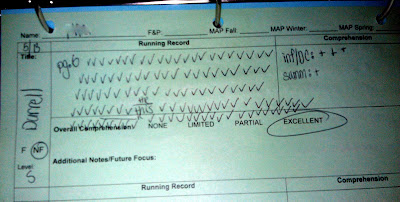
As I said earlier, I use this data when I'm updating students' instructional reading levels and moving them between groups.  I am a big proponent of sharing data with the students.  If I notice a pattern in fluency errors, I will share it with the student.  Before listening to a student read, I may show them on their sheet what we were working on last time.  Every one of my students knows their instructional level and knows where they need to be to be at grade level.  They get so excited when they see that they have moved up a level!

 You can now download a pack of my Guided Reading templates for FREE on Teachers Pay Teachers!  All I ask is that you pay it forward and share the awesome resources you create with the teachers in your life!

Tell me about your guided reading structure!
Related Posts Plugin for WordPress, Blogger...